Showing posts with label infographic. Show all posts

SEEING WITH BIONIC EYES

Viputheshwar Sitaraman
Founder, Blogger
Draw Science.


Article: 
Fine I, & Boynton GM (2015). Pulse trains to percepts: the challenge of creating a perceptually intelligible world with sight recovery technologies. Philosophical transactions of the Royal Society of London. Series B, Biological sciences, 370 (1677) PMID: 26240423

HUMIDITY POWERED ENERGY

Viputheshwar Sitaraman
Founder, Blogger
Draw Science.


Article: 
Xi Chen, Davis Goodnight, Zhenghan Gao, Ahmet H. Cavusoglu, Nina Sabharwal, Michael DeLay, Adam Driks & Ozgur Sahin. (2015). Scaling up nanoscale water-driven energy conversion into evaporation-driven engines and generators. Nature Communications DOI: 10.1038/ncomms8346

ARCS CONFERENCE POSTER

Viputheshwar Sitaraman
Founder, Blogger
Draw Science.

(Click to zoom on image) 

Extremely excited to attend the ARCS Conference 2015 on behalf of Draw Science. A huge thanks to ARCS for their gracious scholarship covering all travel, lodging, and food expenses!

HUMAN EVOLUTION

Yisela Alvarez Trentini
Founder, Designer
Geek Gift

Viputheshwar Sitaraman
Founder, Blogger
Draw Science.

Infographic: Human Evolution

Article:
W. Howard Levie, & Richard Lentz (1982). Effects of text illustrations: A review of research Educational Technology Research & Development, 30 (4), 195-232 : 10.1007/BF02765184

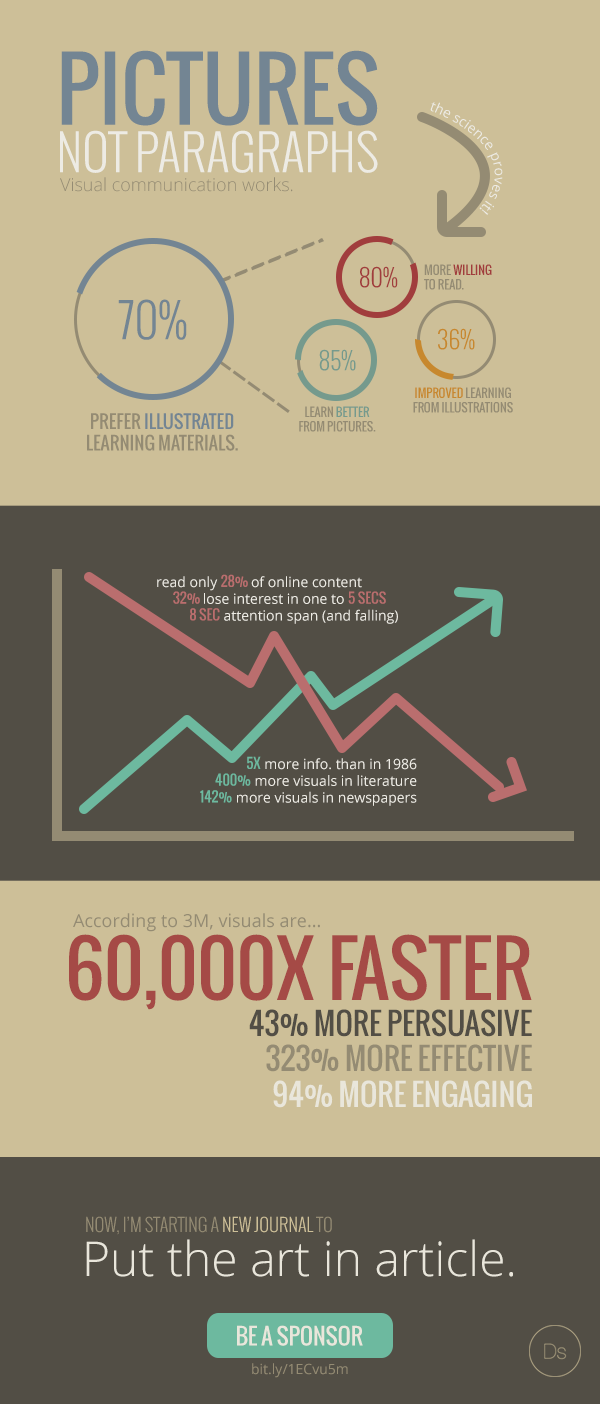
PICTURES, NOT PARAGRAPHS.

Viputheshwar Sitaraman
Founder, Blogger
Draw Science.


Article:
W. Howard Levie, & Richard Lentz (1982). Effects of text illustrations: A review of research Educational Technology Research & Development, 30 (4), 195-232 : 10.1007/BF02765184


PUT THE ART IN ARTICLE

Viputheshwar Sitaraman
Founder, Blogger
Draw Science.


Science communication is broken. Let's fix it.
I've already ranted about the problems with science communication. Even when a layperson gets access to a paper despite all the pay-per-view journals, the use of esoteric jargon makes it practically impossible for the public to read fresh-from-the-lab-bench science. For the last few months, I've been working on a solution through Draw Science. Now it's time to take off the band-aid and treat the wound.

I want to make an open access infographic journal.
We're talking the whole sha-bang: trademarks, corporation filings, DOI's, CLOCKSS archival, etc. By the end of this, Draw Science will have the same legal legitimacy of PLOS or any other online scholarly journal. The barrier is that this costs a little bit of cash; cash that a college student like myself doesn't have.


PS. Sorry for disappearing for a while. I was busy trying to make this happen!

HOW TO UNBOIL AN EGG

Viputheshwar Sitaraman
Founder, Blogger
Draw Science.


Article: 
Yuan, T., Ormonde, C., Kudlacek, S., Kunche, S., Smith, J., Brown, W., Pugliese, K., Olsen, T., Iftikhar, M., Raston, C., & Weiss, G. (2015). Shear-Stress-Mediated Refolding of Proteins from Aggregates and Inclusion Bodies ChemBioChem DOI: 10.1002/cbic.201402427

MUCUS: IT'S SNOT WHAT YOU THINK


Emily Galloway
Thomas Crouzier
Founder
Connected Researchers

Viputheshwar Sitaraman
Founder, Blogger
Draw Science.


FigShare: 
Crouzier, Thomas; co, Julia (2014): Mucus, it's snot what you think. figshare. http://dx.doi.org/10.6084/m9.figshare.1277545

SPACE EXPLORATION 2.0

Viputheshwar Sitaraman
Founder, Blogger
Draw Science.


Article: 
Genta, G. (2014). Private space exploration: A new way for starting a spacefaring society? Acta Astronautica, 104 (2), 480-486 DOI: 10.1016/j.actaastro.2014.04.008

E-CIGS AREN'T SAFE

Viputheshwar Sitaraman
Founder, Blogger
Draw Science.


Article: Grana, R., Benowitz, N., & Glantz, S. (2014). E-Cigarettes: A Scientific Review Circulation, 129 (19), 1972-1986 DOI: 10.1161/​CIRCULATIONAHA.114.007667 [Full Text (PDF)]

Suggested By: Adithya Nott

PREDICTING THE FLU

Viputheshwar Sitaraman
Founder, Blogger
Draw Science.


Article: 
Yuan, Q., Nsoesie, E., Lv, B., Peng, G., Chunara, R., & Brownstein, J. (2013). Monitoring Influenza Epidemics in China with Search Query from Baidu PLoS ONE, 8 (5) DOI: 10.1371/journal.pone.0064323   [Full Text (HTML)]

INVISIBILITY CLOAKS

Viputheshwar Sitaraman
Founder, Blogger
Draw Science.


Article:
Schittny, R., Kadic, M., Buckmann, T., & Wegener, M. (2014). Invisibility cloaking in a diffusive light scattering medium Science DOI: 10.1126/science.1254524

CANCER VACCINE

Viputheshwar Sitaraman
Founder, Blogger
Draw Science.


Article:
Yukai He,, Yuan Hong,, Yibing Peng,, Lisa Butterfield,, Sheng Guo,, David Bartlett,, David Munn1,, Jose Guevara-Patino,, Junfeng Pang,, & Nahid Mivechi (2014). Engineering AFP and GPC3 to create highly immunogenic gene vaccines to prevent carcinogen-induced murine autochthonous hepatocellular carcinoma The Journal of Immunology, 192 (1).

PROCRASTINATION & SLEEP

Viputheshwar Sitaraman
Founder, Blogger
Draw Science.


Article:
Kroese, F., De Ridder, D., Evers, C., & Adriaanse, M. (2014). Bedtime procrastination: introducing a new area of procrastination Frontiers in Psychology, 5 DOI: 10.3389/fpsyg.2014.00611 [Full Text (PDF)]

SELF-HEALING METALS

Viputheshwar Sitaraman
Founder, Blogger
Draw Science.


Article:
Hassan, M., Mehrpouya, M., Emamian, S., & Sheikholeslam, M. (2013). Review of Self-Healing Effect on Shape Memory Alloy (SMA) Structures Advanced Materials Research, 701, 87-92 DOI: 10.4028/www.scientific.net/AMR.701.87 [Full Text (PDF)]

Suggested By: Sritej Attaluri

GENE SCISSORS

Viputheshwar Sitaraman
Founder, Blogger
Draw Science.


*So what does it mean to 'design' the recognition domain? Essentially, engineered nucleases use one of two kinds of proteins: either zinc fingers (ZFs) or TAL effectors (TALEs). Both recognize sequences of DNA. By putting several different ZFs or several different TALEs together -- and choosing the right ones -- scientists can recognize very specific sequences (ie. the gene for sickle cell anemia) and then cut it out.

The first official "Draw Science" post (other than my rant about science communication)! For more information, see the full text of the article I drew by clicking the link below. Be sure to follow and share science with all your nerdy friends and request any articles you'd like drawn out.


Article: Gaj, T., Gersbach, C., & Barbas, C. (2013). ZFN, TALEN, and CRISPR/Cas-based methods for genome engineering Trends in Biotechnology, 31 (7), 397-405 DOI: 10.1016/j.tibtech.2013.04.004 [Full Text (PDF)]

SCIENCE COMMUNICATION SUCKS

Viputheshwar Sitaraman
Founder, Blogger
Draw Science.


PROBLEM
"Was that even English?"
We've all been there after certain lab meetings. Especially in science, we often get wrapped up in the highly specific vocabulary of small areas of research and thus lose touch with the rest of the large and diverse scientific community. Sometimes, we need to step down the language and communicate simply. A researcher and pre-med student myself, I love throwing around the big words. But at the end of the day, I'm just wasting my words whilst my audience doesn't learn anything from what I've said.

SOLUTION
"Explain it to me like I'm five years old."
It's a simple and often used command, but it works like a charm. I admit: dumbing down science can be painful and annoying. However, reducing a seemingly complex and sophisticated biochemical problem to the reading level of a kindergartner often reveals the simple nature of the solution. Simple solutions to difficult problems thrive even today in company cultures like Google and Apple.  As Albert Einstein said, "If you can't explain it simply, you don't understand it."

In my opinion, walls of text (like this one) are intimidating, and frankly boring to read. The concept behind "Draw Science" is straightforward:


Why sift through a long article, when 
I can read a picture book instead?

Essentially, the goal of this blog is to take complex scholarly articles and concepts and reduce them to infographics capable of being understood by laymen. To stick to this philosophy, I've developed a couple strategies:
  1. Trim it down: get rid of any terminology or information that isn't relevant to understanding the big picture. People who are interested in the fine details will go find those themselves.
  2. Word economy: complete sentences and unnecessary terminology are the foremost cause of 'paragraph obesity'. Budget words and use more pictures.
  3. Keep it schematic: As pretty as helices and plaits are, schematic diagrams are far easier to understand than 3D protein models. 
  4. Arrows: Science is a sequence. Scientists like flowcharts. I like pictures. Accordingly, use arrows to add motion and change into static diagrams.
  5. Stand-alone: The biggest difficulty of making an infographic is making sure that its concise but it can still stand alone.
With that being said, I leave a few concluding remarks. Science communication sucks...but, we can change that. No communication means no outreach, no outreach means no public support, no support means no funding. Simplicity, especially with pictures, is my way of improving science outreach: by making it understandable--or at least attractive. Nobody wants to read about 3-glycohydronitrahexasulfate (no that's not a real thing), UNLESS it can cure cancer. Presentation matters. The point of this blog is to be a kind of mediator between jargon-filled scholarly literature and the curious public.

Got an idea? Tell me.

-

Name

Email *

Message *