Showing posts with label medicine. Show all posts

SEEING WITH BIONIC EYES

Viputheshwar Sitaraman
Founder, Blogger
Draw Science.


Article: 
Fine I, & Boynton GM (2015). Pulse trains to percepts: the challenge of creating a perceptually intelligible world with sight recovery technologies. Philosophical transactions of the Royal Society of London. Series B, Biological sciences, 370 (1677) PMID: 26240423

MUCUS: IT'S SNOT WHAT YOU THINK


Emily Galloway
Thomas Crouzier
Founder
Connected Researchers

Viputheshwar Sitaraman
Founder, Blogger
Draw Science.


FigShare: 
Crouzier, Thomas; co, Julia (2014): Mucus, it's snot what you think. figshare. http://dx.doi.org/10.6084/m9.figshare.1277545

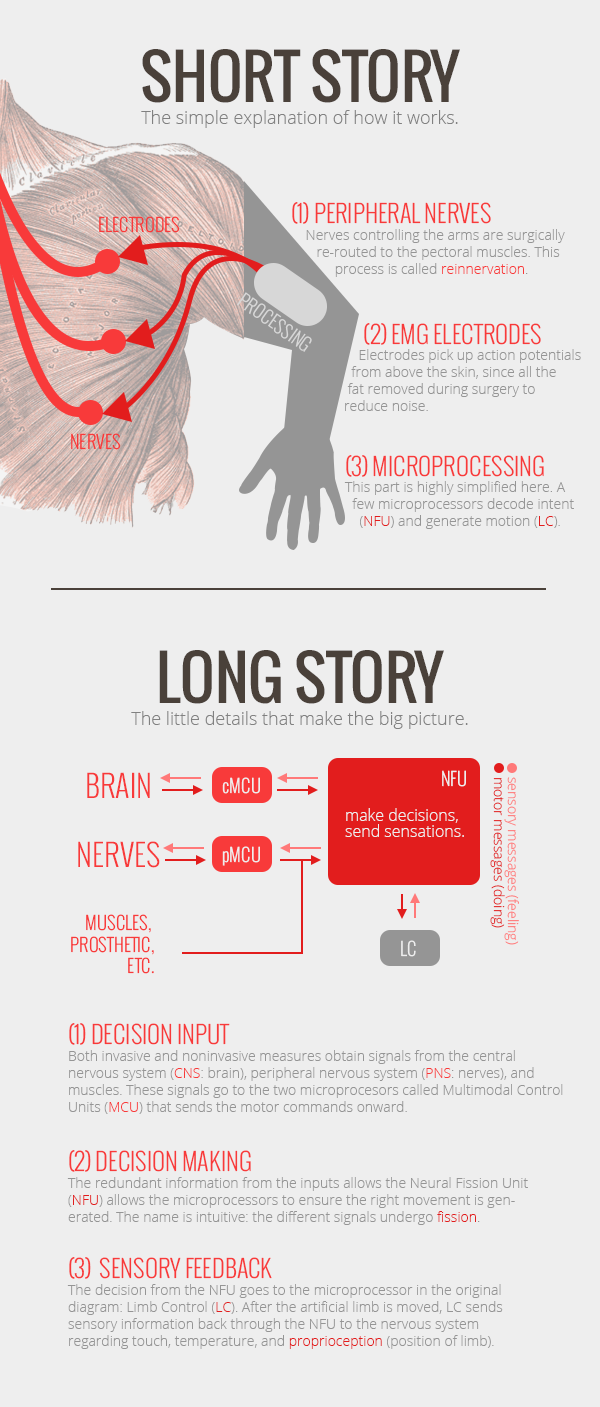
MIND-CONTROLLED PROSTHETICS

Viputheshwar Sitaraman
Founder, Blogger
Draw Science.


Article: 
Collinger, J., Wodlinger, B., Downey, J., Wang, W., Tyler-Kabara, E., Weber, D., McMorland, A., Velliste, M., Boninger, M., & Schwartz, A. (2013). High-performance neuroprosthetic control by an individual with tetraplegia The Lancet, 381 (9866), 557-564 DOI: 10.1016/S0140-6736(12)61816-9

WASH YOUR HANDS!

Emily Galloway
Emily Galloway
Columnist
The Wannabe Scientist

Viputheshwar Sitaraman
Founder, Blogger
Draw Science.


Until the late 19th century, it was odd for doctors, let alone people in general, to wash their hands. But in 1847, Dr. Semmelweis discovered that the spread of puerperal fever, a fatal disease commonly contracted by women in labor, was reduced when obstetric nurses disinfected their hands. Dr. Semmelweis proposed that microbes transferred between people could spread infection, and his solution was the invention of hand disinfection (2).

Good hygiene leads to less disease? This sounds like a no-brainer to us in the 21st century, but a lot of people are not taking advantage of the simplest way to minimize the spread of disease: hand-washing. In a study of college students, “63% washed their hands, but only 38% used soap. Then, 32% used soap between 5 and 10 seconds, and a microscopic 2% used soap to wash for more than 10 seconds” (1). These statistics are not only disgusting, but also frightening when you think about how many diseases can be spread by unclean hands.
Clean hands are especially important in healthcare environments. Health care associated infections and multi-drug resistant bacteria are slowly becoming more prevalent and difficult to treat (3). Dr. Wilson’s study at University College Hospital in London attests to the importance of hand washing in fighting against multi-drug resistant bacteria. He demonstrated that hand washing was more effective in controlling MRSA, a superbug spread in hospitals, than patient isolation (5).If doctors’ first line of defense against disease is hand washing, then we could all use some of their tips to effectively clean our hands.
  1. Wet your hands with clean, running water.
  2.   Lather your hands by rubbing them together with soap. Make sure to get those easy-to-forget areas like in-between your fingers, the backs of your hands, and under your fingernails.
  3. Scrub your hands and the same easy-to-forget areas for at least twenty seconds.
  4. Rinse off all of the soap under clean, running water.
  5. Dry off your hands with a clean towel, paper towels, or an air dryer, not the legs of your pants (4).
It’s an added bonus if you wash with your hands up and your wrists pointing down, just like a surgeon! This method causes the bacteria to flow away from your fingertips and hands, the most important areas to keep clean.

Washing your hands is a simple, yet effective way to fight the spread of disease. For the sake of Dr. Semmelweis, who was not even recognized for his radical discovery that helped save countless lives, please take the time to wash your hands correctly!


PERSONALIZED MEDICINE

Emily Galloway
Emily Galloway
Columnist
The Wannabe Scientist

Viputheshwar Sitaraman
Founder, Blogger
Draw Science.


What if the majority of patients could walk into hospitals before they are sick rather than after they have suffered from disease symptoms? What if oncologists could be confident that each of their patients’ conditions will be improved after therapy? What if physicians could design unique treatments for patients? Soon, all this may be possible thanks to the combination of rapidly-advancing technology and a burgeoning, new medical philosophy:


Personalized medicine uses genetic profiling to create individualized prevention or treatment plans for patients. The idea of personalized medicine is not new, but now scientists finally have the technological capabilities to make it possible. The cost of sequencing a whole genome has plummeted from $100-300 million in 2001 to about $5,000 in 2011 (1). Once the price has dropped to under $1,000, scientists believe that whole-genomic sequencing can become a part of standard medical care. Then, physicians can design personalized treatments for patients based on reliable information and risk factors evident in their genomes.


However, the seemingly innocuous concept of sequencing people's genomes to improve medicine comes with tradeoffs: although it can significantly enhance preventive medicine and streamline drug treatments, personalized medicine also raises several concerns in terms of finance and liability, as well ethical issues with genome editing. In short, personalized medicine has its obvious benefits, but also some less obvious non-medical concerns that are nevertheless important.

BENEFITS
PREVENTION
A principle of personalized medicine is transitioning the focus from treating disease to preventing disease. Genetic and protein tests allow patients to know if they are at risk for a disease and take early action to prevent its development. Certain mutations of the BCRA1 and BCR2 genes indicate high risks of developing breast cancer (1). Now that these tests are available, women at risk can take action by getting frequent mammograms, which can increase the likelihood of catching cancer at an early stage. By switching the focus of medicine to prevention, less people will experience the financial, physical, and emotional pains of late-stage diseases.

TREATMENT
Ineffective drugs are costly – both financially and physically. Studies have shown that “38 percent of depression patients, 50 percent of arthritis patients, 40 percent of asthma patients, and 43 percent of diabetic patients will not respond to initial treatment” (1). However, better understanding drug metabolism and genetic correlations may soon eradicate the practice of “trial-and-error diagnosis.” Patients will be able to receive drugs that were specifically chosen because they have been proven to work effectively in patients with similar genetic profiles. Also, physicians will be able to assign drug dosages based on each patient’s metabolism and genetic factors; this emerging field is called pharmacogenetics. Tests for biomarkers, proteins associated with certain diseases, will additionally allow physicians to more accurate diagnose and treat illnesses. These tests will make treatments more personalized and effective by increasing patient adherence to drugs and minimizing harmful reactions to drugs.

But these ideas are not just theoretical – physicians have begun to practice these techniques recently. Among several other mutation-specific drugs, Zelboraf™ more effectively treats melanoma patients who have the BRAF V600E gene mutation. The drug Ziagen® can cause fatal effects to a small percentage of HIV patients that have the HLA-B*5701 gene, but all patients that receive the drug are genetically testing beforehand, which saves countless lives (1).

DRAWBACKS
INSURANCE
People are questioning if and how insurance will cover genome sequencing and the multitude of new genetic and biomarker tests. Even if insurance will provide aid to pay for personalized therapies, millions of people do not have healthcare. How can access to personalized medicine be provided to everyone, or is this even an attainable goal? (4).

LIABILITY
Physicians are already being involved in lawsuits claiming that patients should have been testing for a genetic predisposal to a disease. Soon, lawsuits will appear about physicians’ failure to perform genetic tests before prescribing medications. These issues introduce a new class of possible legal problems for doctors (3). Rules must be established to mitigate these disputes and protect physicians and patients.

PRIVACY
Lastly, concerns over privacy, specifically genetic privacy, have arisen in conjunction with the advancement of personalized medicine. Protecting individuals’ health information is extremely important, but where is the line drawn for genetic information? Creating a database full of anonymous genetic profiles with treatment results could be a way to quickly spread genetic and drug breakthroughs and inform doctors about high-risk genes, but does this violate the privacy of individuals? Also, if a person is diagnosed with a genetic disease and his or her family members are recommended to get tested for said disease, does this infringe on the privacy of that person? (3). Several other difficult questions about privacy must also be addressed to organize personalized medicine.

FUTURE
There are benefits and risks involved in personalized medicine, but learning about the aspects of this practice is a step in the right direction. Physicians must have additional training in genetics before adopting a personalized medicine approach. More gene-specific drugs must be developed to better prevent and treat diseases. Lastly, people’s minds must be open to a new philosophy that could catapult us into a new era of medicine.


TELEPATHY IS ALMOST HERE

Viputheshwar Sitaraman
Founder, Blogger
Draw Science.


Article: Grau C, Ginhoux R, Riera A, Nguyen TL, Chauvat H, Berg M, Amengual JL, Pascual-Leone A, & Ruffini G (2014). Conscious Brain-to-Brain Communication in Humans Using Non-Invasive Technologies. PloS one, 9 (8) PMID: 25137064 [Full Text (HTML)]

Suggested By: Adithya Nott

FIST BUMP, DON'T HANDSHAKE.

Viputheshwar Sitaraman
Founder, Blogger
Draw Science.


Article: Ghareeb, P., Bourlai, T., Dutton, W., & McClellan, W. (2013). Reducing pathogen transmission in a hospital setting. Handshake verses fist bump: a pilot study Journal of Hospital Infection, 85 (4), 321-323 DOI: 10.1016/j.jhin.2013.08.010 [Full Text (PDF)]

Suggested By: Samarth Rawal

ONE GENE, ONE CANCER

Viputheshwar Sitaraman
Founder, Blogger
Draw Science.


Article: Hingorani SR, Jacobetz MA, Robertson GP, Herlyn M, & Tuveson DA (2003). Suppression of BRAF(V599E) in human melanoma abrogates transformation. Cancer research, 63 (17), 5198-202 PMID: 14500344 [Full Text (PDF)]

Suggested By: Emily Galloway

GLASSES-FREE COMPUTERS

Viputheshwar Sitaraman
Founder, Blogger
Draw Science.


Article: Huang, F., Wetzstein, G., Barsky, B., & Raskar, R. (2014). Eyeglasses-free display ACM Transactions on Graphics, 33 (4), 1-12 DOI: 10.1145/2601097.2601122 [Full Text (PDF)]

Suggested By: Adithya Nott

HOTTER, SMARTER, BETTER BRAINS.

Viputheshwar Sitaraman
Founder, Blogger
Draw Science.


Articles:
James F. Gillooly (2013). Hotter is Smarter: The temperature-dependence of brain size in vertebrates PeerJ : 10.7287/peerj.preprints.155v1 [Full Text (PDF)]
Wright KP Jr, Hull JT, & Czeisler CA (2002). Relationship between alertness, performance, and body temperature in humans. American journal of physiology. Regulatory, integrative and comparative physiology, 283 (6) PMID: 12388468 [Full Text (PDF)]

PLANT = PILL?

Viputheshwar Sitaraman
Founder, Blogger
Draw Science.


Article: Tran TV, Malainer C, Schwaiger S, Atanasov AG, Heiss EH, Dirsch VM, & Stuppner H (2014). NF-κB inhibitors from Eurycoma longifolia. Journal of natural products, 77 (3), 483-8 PMID: 24467387 [Full Text (PDF)] 

                              Principal Investigator 
                              Department of Pharmacognosy, Vienna

Got an idea? Tell me.

-

Name

Email *

Message *